

Service area · Washington County, New York

Water testing and treatment for Washington County farms, villages and homes

Washington County is village water systems surrounded by farmland and private wells. The water changes with the bedrock, from the slate belt around Granville to the limestone of the Champlain Valley, and many wells sit close to working agriculture.

Water in Washington County

The villages run their own water systems: Hudson Falls, Fort Edward, Greenwich, Cambridge, Salem, Granville and Whitehall each supply the homes inside the village line and sometimes a district just outside it. These supplies are disinfected, and several draw groundwater, so households inside the villages can have both chlorine taste and odor and hardness to deal with.

Outside the villages the county is on private wells. Along the Hudson and in the Batten Kill valley the wells are in sand and gravel or in shale; around Granville and Hebron they are in the slate that built the roofing industry; in Whitehall, Dresden and Putnam they reach the limestone and dolostone of the Champlain Valley, where water is often very hard. Iron and manganese staining and the occasional sulfur odor are familiar across the county.

Washington County is dairy and crop country. Shallow or older wells near fields, barnyards or manure storage should be tested by a certified laboratory for bacteria and nitrate, which no in-home screening can replace. We help homeowners read those results and, where treatment makes sense, recommend equipment that addresses what the lab found.

Towns and villages we visit in Washington County

  • Hudson Falls
  • Fort Edward
  • Kingsbury
  • Greenwich
  • Cambridge
  • Salem
  • Granville
  • Whitehall
  • Fort Ann
  • Argyle
  • Easton
  • Hebron
  • Hartford
  • Jackson
  • Putnam
  • White Creek
  • Dresden
  • Hampton

Town list is for orientation and is not exhaustive. If your town is in Washington County and is not listed, we still serve it.

What we usually find in Washington County homes

  • Hardness and chlorine on village water systems.
  • Very hard water on wells in the Champlain Valley limestone around Whitehall and Dresden.
  • Iron, manganese and sulfur odor on rural wells; nitrate as a lab-test concern near agriculture.
  • Farmhouses with older plumbing that need a careful look at where equipment can go.

Your water is confirmed at your tap

These are patterns, not predictions. Two homes on the same road can test differently, and municipal water changes with the season and the source in use. The in-home assessment measures your water; for health-related questions on a private well we point you to a New York State ELAP-certified laboratory and your county health department.

How we work in Washington County

Hudson Falls, Fort Edward and Greenwich are 20 to 30 minutes east and north of Ballston Spa; Granville and Whitehall about an hour. The process is the same as everywhere we work: an in-home water test, a written recommendation that fits your results and your household, and installation by experienced local plumbers. There is no showroom and nothing to buy online; we come to you.

What fits here

Treatment options for Washington County homes

Every recommendation follows the water test. These are the directions the test most often points to in Washington County.

Municipal water

Whole-house softening and filtration

Homes on village water in Hudson Falls, Fort Edward, Greenwich, Cambridge, Salem, Granville or Whitehall are candidates for a C-series combination system when hardness and chlorine are both present.

Whole-house filtration Water softeners
Private wells

Lab test first, then treatment that fits

Rural wells are tested by a certified laboratory first, with bacteria and nitrate on the list for any well near agriculture. Iron, manganese and sulfur are treated with configurations designed for undisinfected wells rather than the C-series.

Well vs municipal water Reading a lab report

Drinking water

Reverse osmosis at the kitchen sink

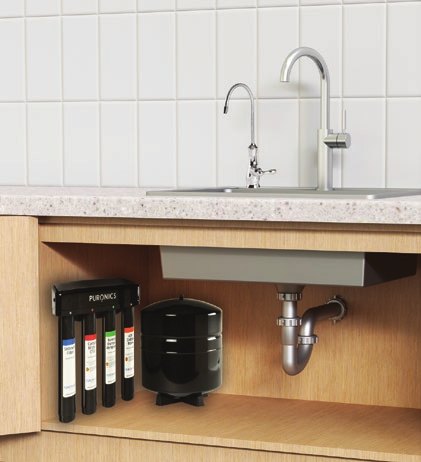
The Micromax 8500 reverse-osmosis system provides certified reduction of nitrate, lead, arsenic and other dissolved contaminants in drinking and cooking water, which is why it is a frequent recommendation for farm-country homes.

Reverse osmosis Micromax 8500

Washington County questions

Our well is near fields. Should we worry about nitrate?

Nitrate is a health-related contaminant that only a certified laboratory can measure reliably, and New York State recommends well owners test for it. If a lab finds nitrate above the standard, a reverse-osmosis system at the kitchen sink is one established way to reduce it in drinking water; we will show you the certification and discuss whether it fits your result. We do not test for nitrate in the home.

Our water smells like rotten eggs. Is that dangerous?

The odor is usually hydrogen sulfide gas, produced by sulfur bacteria or by minerals in the aquifer. It is a nuisance more than a health risk at the levels found in wells, but it corrodes plumbing and makes water unpleasant to use. It needs its own treatment step; a standard softener does not remove it. We confirm the source and recommend accordingly.

Do you cover Granville, Whitehall and the Vermont line?

Yes, all of Washington County. For towns along the Vermont border, ask; we will tell you plainly whether a property just over the line is one we can serve.

Start with a water test in Washington County

Tell us about your home and what you have noticed. We will be in touch to arrange an in-home water test anywhere in Washington County.