

Installation
Installed by experienced local plumbers, commissioned before we leave
A water treatment system is only as good as its installation. Here is how we plan it, what the work involves, and what you will know about your system when it is done.
Planning before the install day
Most installation questions are answered during the in-home assessment, because we are already standing in your mechanical room. Before scheduling we confirm:
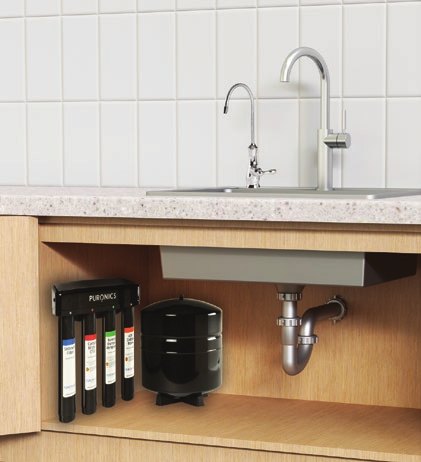
- Equipment location. Whole-house systems go on the main line after the meter or pressure tank, with room for the media tank and the brine tank and clearance to service the valve. Reverse-osmosis systems go under the kitchen sink.
- Plumbing access. The main line is cut and the system is plumbed in with a bypass so the house can run on untreated water during service. We note pipe material and size, and whether outdoor spigots or irrigation should be plumbed around the system.
- Drain. Softener regeneration, media backwash, and RO reject water all need a drain. A floor drain, utility sink, standpipe, or condensate-style drain line is required within reach; we plan the route and the air gap.
- Electrical. The control valve needs a standard grounded outlet. RO systems need none.
- Site-specific requirements. Crawl spaces, finished basements, tight sink cabinets, long drain runs, and older plumbing each change the plan. We tell you what is involved before you approve the quote, not after.
What gets installed

Who does the work
Every system we sell is installed by experienced local plumbers. We work with experienced plumbing professionals from our own region rather than a traveling crew, and we coordinate the schedule, the equipment delivery, and the commissioning so you deal with one company. If any part of the job needs a permit under your municipality's rules, we will tell you how that is handled for your project.
Documentation on request
We describe our installers as experienced local plumbers because that is what they are. We have not published their employment relationship, individual license numbers, or insurance certificates on this page; ask us and we will provide the relevant documentation for your project with the quote.
What happens on installation day
- Water is shut off and the main line is prepared; for RO, the sink cabinet is cleared.
- Equipment is set in place, plumbed in with a bypass, and connected to the drain with a proper air gap.
- The control valve is programmed for your measured hardness, household size, and local conditions.
- For softener and filter combinations, the brine tank is filled and the system runs its first backwash and regeneration cycle.
- For RO, the system is flushed per the manufacturer's start-up procedure and the tank is filled and emptied before first use.
- Every connection is checked for leaks under pressure, and treated water is tested at a tap to confirm the system is performing.
Commissioning and your walkthrough
Before the plumbers leave you get a walkthrough of your system: what the display shows, how and when to add salt or potassium, how to put the system in bypass, how to change an RO cartridge, what normal regeneration sounds like, and who to call. You receive the owner's manuals and the manufacturer's written limited warranty. We want you to be comfortable with the equipment, not dependent on us for basic questions.
Ownership after installation
Whole-house systems need salt or potassium chloride on an ongoing basis and otherwise run automatically; RO systems need periodic cartridge changes. The manufacturer's disclaimer applies: operational maintenance and replacement requirements are essential for the product to perform as advertised. We go through the schedule and the warranty terms with you so there are no surprises, and our guide to cost and ownership covers what to budget.
What we do not promise
We do not quote exact completion times on this page because they depend on the home. We do not claim that labor, consumables, or every component are covered by the manufacturer's warranty; the written terms govern and we will show you exactly what they say. If a project needs electrical work, a new drain, or plumbing repairs beyond the installation itself, that is identified and priced before you approve anything.
Installation questions
Will installation disrupt my water service?
Water is off while the main line is cut and the system is connected, then restored once connections are tested. We tell you the expected window when we schedule the job.
Can the system go outside or in the garage?
Equipment must be protected from freezing, which rules out most unheated spaces in our climate. We identify a suitable indoor location during the assessment.
Do you install systems bought elsewhere?
Our installation service is for the Puronics systems we sell, because that is what we can commission, warranty-register, and support properly.
Start with your water, not a catalog
Every recommendation begins with an in-home water test and a conversation about how your household uses water. Tell us about your home and we will be in touch to arrange a visit.