

Reverse osmosis
Drinking and cooking water, treated at the kitchen sink
Reverse osmosis is the point-of-use step: a compact under-sink system with its own faucet, certified to reduce specific dissolved contaminants in the water you actually drink.
Why treat drinking water separately
Whole-house systems handle hardness and disinfectant for every fixture, but the water you drink and cook with is a small fraction of what a house uses, and it is the fraction where dissolved contaminants matter most. Treating it at one faucet with reverse osmosis is more thorough, and far more economical, than trying to treat the whole house to drinking-water standards. Many households pair a whole-house combination system with an RO at the kitchen sink; some choose RO alone.
How reverse osmosis works
Household water pressure pushes water against a semi-permeable membrane. Water molecules pass through; most dissolved salts, metals and other impurities do not, and are flushed to the drain. Pre-filters protect the membrane from sediment and chlorine, a post-filter polishes taste, and the treated water collects in a small pressurized tank so the dedicated faucet delivers it on demand.
The five stages of the Micromax 8500

- Sediment filter. Protects the system by removing dirt, rust, and sediment as small as 2/10,000 of an inch.
- Activated carbon filter. High-capacity 5-micron graded-density carbon. Puronics states this stage effectively reduces PFAS chemicals (the certified claim is PFOA/PFOS under NSF/ANSI 53).
- Ultrafiltration. A super-fine barrier to waterborne cysts such as Cryptosporidium and Giardia, if present, with a self-cleaning process. Cyst reduction is a manufacturer description, not among the listed certifications.
- Reverse osmosis. A membrane allows water molecules to pass while impurities are flushed to drain. Treated water is stored in a sealed tank.
- Carbon-block polish. A high-density carbon block polishes water from the storage tank, removing unpleasant tastes and odors.
What it is certified to reduce
Performance claims on this site rest on third-party certification. For the Micromax 8500, Puronics lists Water Quality Association testing and certification to these standards:
| Standard | Certified claim |
|---|---|
| NSF/ANSI 58 | Reduction of arsenic, barium, cadmium, hexavalent chromium, trivalent chromium, copper, fluoride, lead, radium 226/228, selenium, turbidity, and total dissolved solids (TDS) |
| NSF/ANSI 42 | Chlorine taste and odor (aesthetic) |
| NSF/ANSI 53 | VOCs and PFOA/PFOS |
| NSF/ANSI 401 | Bisphenol A, estrone, ibuprofen, naproxen, nonylphenol (emerging compounds) |
| NSF/ANSI 372 | Low-lead compliance of wetted components (construction standard, separate from the NSF/ANSI 58 lead-reduction claim) |
Reading certifications correctly
A certification covers the listed contaminants under the test conditions of the standard, not every substance in a category. "Reduces PFOA/PFOS" is a certified claim; "removes all PFAS" is not, and we do not make it. Cyst reduction (Cryptosporidium, Giardia) is a manufacturer description of the ultrafiltration stage rather than a listed certification. Reverse osmosis is not a substitute for disinfection on a microbiologically unsafe supply. Manufacturer disclaimer: contaminants or other substances which can be reduced by this system are not necessarily present in your water.
Household fit
- Space. The system and its storage tank fit under a typical kitchen sink; Puronics describes a slim-profile design. We measure during the assessment.
- Pressure. It runs on household water pressure with no electricity. Puronics does not publish a minimum pressure on its product page; we confirm your pressure on site, and a booster can be discussed if needed.
- Drain. RO sends reject water to the drain during operation, so a drain connection under the sink is required.
- Faucet. A dedicated long-neck faucet is installed at the sink; a kitchen faucet adapter connects the system to the cold supply without special plumbing.
- Refrigerator and ice. Many homeowners run a line from the RO to the refrigerator dispenser and ice maker; we can plan for it.
Maintenance
Pre- and post-filter cartridges are replaced periodically; the membrane less often. The Micromax 8500 uses patented Easy Change cartridges that shut off the water automatically when removed, so replacement is a quick twist with no leaks or mess. Puronics does not publish replacement intervals on the product page; they are in the owner's manual and depend on your water, and we set the schedule with you at installation. The manufacturer's warranty document, which we provide with the quote, governs coverage.
Water use
Every RO system sends some water to drain for each gallon it produces; this is how the membrane stays clean. The amount depends on pressure, temperature and water chemistry. For drinking-water volumes it is a modest cost, which is part of why RO is a point-of-use rather than whole-house technology.
RO and whole-house treatment together
Softened, dechlorinated feed water is easier on an RO membrane: chlorine degrades thin-film membranes and hardness scales them. A whole-house combination system upstream therefore tends to extend RO membrane life, and the RO in turn removes the small amount of sodium that softening adds at the one faucet where it matters. The combination is common for that reason, but it is not mandatory; the assessment determines what your water needs.
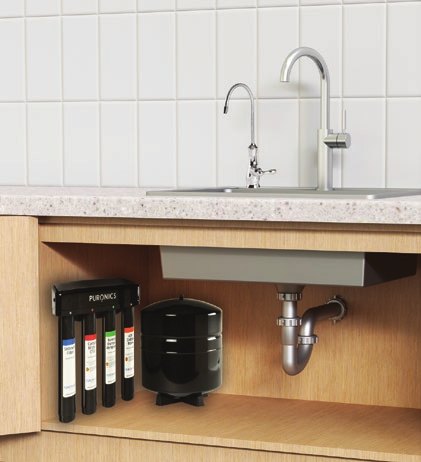
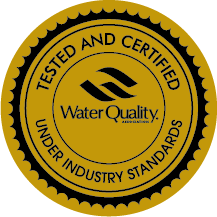
The Micromax 8500 is WQA certified to NSF/ANSI 58, 42, 53, 401 and 372. The certified claims are listed on this page; we do not extend them.
Featured system
Micromax 8500
Five-stage under-sink reverse-osmosis drinking-water system with Easy Change cartridges.
Full product pageConsider RO if you
- Buy bottled water for taste or peace of mind
- Have lab results showing lead, arsenic, fluoride, nitrate or PFOA/PFOS
- Soften your water and want sodium-free drinking water
- Want better coffee, tea, ice, and cooking water
Reverse osmosis questions
Does RO remove healthy minerals?
RO reduces most dissolved minerals along with contaminants, which is why the water tastes clean and flat to some people at first. Most dietary minerals come from food rather than water. If you prefer a mineral taste, remineralizing post-filters exist; ask us during the assessment.
Is RO necessary if I am on municipal water?
Not necessarily. Municipal water is regulated and monitored at the plant. Homeowners choose RO for taste, to remove the sodium a softener adds, to address lead from household plumbing, or because a lab result or the town’s report shows something they want reduced at their own tap. We will not tell you municipal water is unsafe; we will help you decide whether a drinking-water system is worth it to you.
How much water does the tank hold, and how fast does it refill?
Puronics does not publish the tank size or production rate on the Micromax 8500 product page, and both depend on your pressure and water temperature. We confirm those details from the manufacturer documentation and your site conditions with the quote rather than guessing here.
Can RO treat well water?
RO is often part of a well-water solution for drinking water, after a certified laboratory test identifies what is present and after any sediment, iron, or disinfection needs upstream are handled. RO alone is not a treatment for bacteria. See well water vs municipal water.
Start with your water, not a catalog
Every recommendation begins with an in-home water test and a conversation about how your household uses water. Tell us about your home and we will be in touch to arrange a visit.